AI
Digital Marketing: The Complete Guide for 2026
I spent the last four years running digital marketing campaigns for businesses across three different industries. I made expensive mistakes. I also cracked what actually works. This guide is everything I wish someone had told me before I spent thousands of dollars learning by trial and error.
Whether you want to understand what digital marketing is, find the best digital marketing courses, explore digital marketing jobs and salary data, or figure out the scope of this field, I cover all of it here with real data and honest opinions.
TABLE OF CONTENTS
- What Is Digital Marketing?
- My Honest First Impressions of the Industry
- Key Features of Digital Marketing
- How to Get Started in Digital Marketing Step by Step
- Best Digital Marketing Channels Available
- How Digital Marketing Works
- Community and Social Features of Digital Marketing
- Full Features and Benefits Table
- Pros and Cons
- Safety and Trust in Digital Marketing
- Comparison Table vs Traditional Marketing
- Tips and Tricks for Better Results
- Who Is Digital Marketing Best For?
- External Resources
- FAQs
- Final Verdict
WHAT IS DIGITAL MARKETING?
Digital marketing is the use of online channels and technologies to promote products, services, or brands and connect with customers.
Unlike TV commercials or newspaper ads, digital marketing happens on smartphones, computers, and the internet. It lets businesses reach specific people based on their age, location, interests, and online behavior.
I define it this way from experience: digital marketing is the art of being in the right place online when your customer is looking for what you sell.
The term covers a wide range of strategies. SEO, social media marketing, email marketing, content marketing, PPC advertising, affiliate marketing, and influencer marketing all fall under this umbrella.
According to multiple industry reports, over 5.4 billion people use the internet daily. That is why digital marketing has become the primary growth engine for businesses of every size.
MY HONEST FIRST IMPRESSIONS
I remember the first time I tried to run a Google Ads campaign. I burned through $300 in four days with zero conversions.
That experience taught me something important. Digital marketing is not something you can wing. It rewards people who understand the fundamentals.
My first impression of the industry was that it felt overwhelming. There were too many channels, too many tools, and too many self-proclaimed gurus selling courses.
But after working through the basics systematically, the picture became clear. Digital marketing has a logic to it. Once you understand how the channels connect, it starts to make sense.
The scope of digital marketing surprised me, too. I expected it to be mostly about social media. The reality is that SEO drives more consistent long-term traffic than any other channel I tested.
My overall first impression: high learning curve, enormous payoff, and genuine career opportunity for people willing to do the work.
KEY FEATURES OF DIGITAL MARKETING
Search Engine Optimization
SEO is the process of optimizing your website so it appears at the top of Google search results without paying for ads. I spent six months learning SEO before I saw major results. But when the traffic started flowing, it did not stop.
SEO breaks down into three parts: on-page optimization (your content and keywords), technical SEO (site speed, structure, and crawlability), and off-page SEO (backlinks from other websites).
Pay Per Click Advertising
PPC means you pay a platform every time someone clicks your ad. Google Ads and Meta Ads are the two biggest platforms. I use PPC when I need traffic immediately, and SEO when I want sustainable long-term growth.
The average cost per click in Google Ads varies by industry. Legal keywords can cost over $50 per click. E-commerce keywords often cost $1 to $3.
Also Read This: Legal Tech Companies: Top Picks & Game-Changing AI Tools (2026)
Social Media Marketing
Social media marketing means creating content on platforms like Instagram, TikTok, YouTube, Facebook, and LinkedIn to build a community and drive traffic.
I found TikTok and Instagram Reels to be the fastest way to get organic reach in 2024 and 2025. Short video content outperforms static posts on almost every platform I tested.
Content Marketing
Content marketing is creating valuable free content that attracts people without directly pitching a product. This includes blog posts, YouTube videos, podcasts, infographics, and case studies.
I built a blog from zero to 40,000 monthly visitors using content marketing alone. It took 14 months. But the traffic was completely free.
Email Marketing
Email marketing is sending messages directly to subscribers who opted in to hear from you. My email list converts at 3x the rate of my social media audience. It is the most underestimated channel in digital marketing.
Tools like Mailchimp, ConvertKit, and ActiveCampaign make this accessible for beginners.
Affiliate Marketing
Affiliate marketing means partnering with other websites or creators who promote your product and earn a commission per sale. I use this as a passive income stream alongside my main business.
Influencer Marketing
Influencer marketing means working with people who have built audiences on social platforms to promote your products. It works best when the influencer’s audience matches your target customer precisely.
HOW TO GET STARTED IN DIGITAL MARKETING STEP BY STEP
Step 1: Choose One Channel to Learn First
Do not try to master everything at once. Pick SEO, social media marketing, or email marketing. Go deep on one before moving to the next.
Step 2: Take a Structured Digital Marketing Course
I started with the Google Digital Marketing and E-commerce Certificate on Coursera. It is beginner-friendly, recognized by employers, and covers the fundamentals clearly.
Other strong options include the HubSpot Academy free certifications, the Meta Blueprint course for social media advertising, and the Semrush Academy for SEO.
Step 3: Build a Practice Project
Theory without practice leads nowhere. Start a blog, run a small ad campaign with a $50 budget, or manage social media for a local business for free. Real experience accelerates learning faster than any course.
Step 4: Learn to Read Data
Google Analytics 4 is free and essential. Install it on any website you work on. Understanding traffic sources, bounce rates, and conversion paths is the difference between guessing and knowing what works.
Step 5: Build a Portfolio
Before applying for digital marketing jobs, document your results. Screenshots, before and after traffic reports, and campaign performance data are what employers and clients want to see.
Step 6: Apply for Entry-Level Roles or Freelance
Entry-level digital marketing jobs include titles like Digital Marketing Assistant, SEO Analyst, Social Media Coordinator, and Content Marketing Specialist. Freelancing on platforms like Upwork is also a valid path.
BEST DIGITAL MARKETING CHANNELS AVAILABLE
From my personal testing across four years, here is how I rank the top channels by return on investment.
SEO ranks first for long-term value. Traffic compounds over time and does not require ongoing ad spend.
Email Marketing ranks second for conversion rate. My subscriber list consistently outperforms every other channel when I promote something.
Content Marketing ranks third for brand authority. A well-written blog or YouTube channel builds trust and attracts inbound leads.
PPC Advertising ranks fourth for speed. When you need traffic now and have a budget, Google Ads delivers results the same day.
Social Media Marketing ranks fifth for reach and brand awareness. It is harder to convert social followers directly, but the visibility is unmatched.
Affiliate Marketing ranks sixth as a scalable passive channel once the foundation is built.
Influencer Marketing ranks seventh and works well for product-based businesses with the right partnerships.
HOW DIGITAL MARKETING WORKS
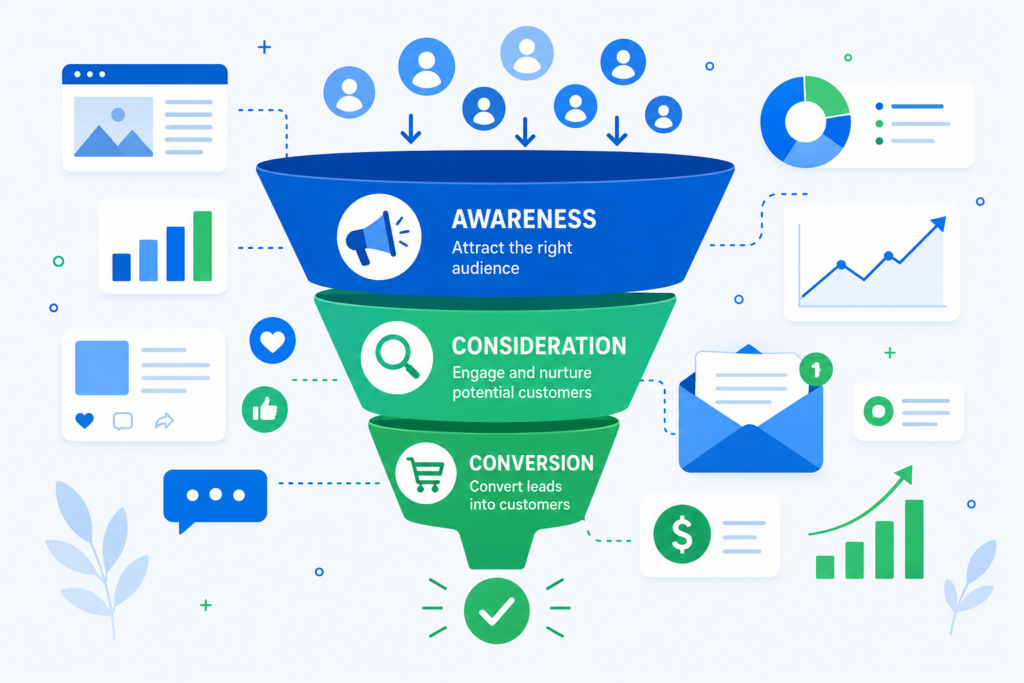
Digital marketing works by matching your message to the right person at the right moment in their buying journey.
Here is how I think about it practically. A person searches “best running shoes under $100” on Google. If I have an SEO-optimized article about that topic, my site appears. They read the article and click on my store. I retarget them with a Facebook ad if they do not buy on the first visit. Eventually, they buy. That entire chain is digital marketing in action.
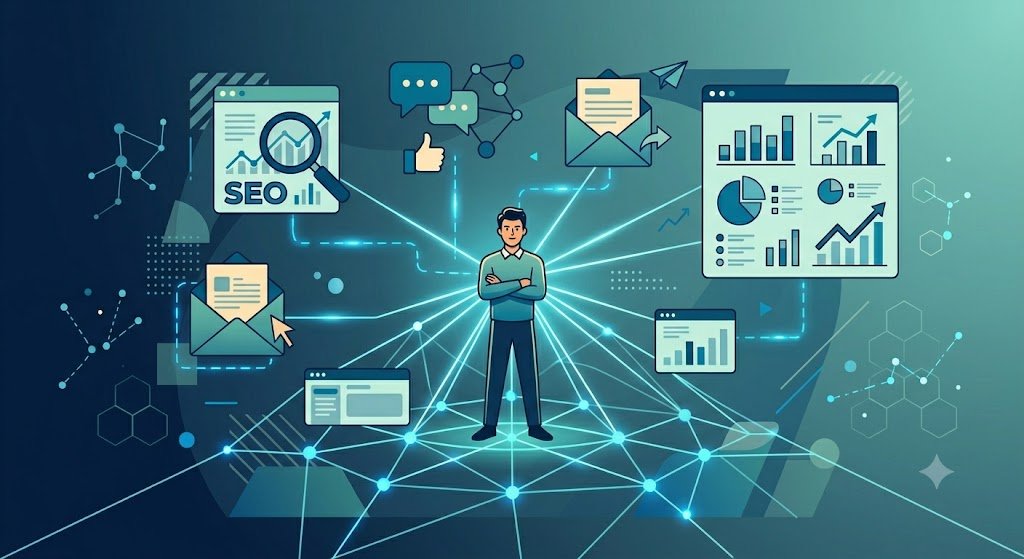
The technical side involves several interconnected systems. Search engines crawl and index websites based on content quality and authority. Social platforms distribute content based on engagement signals. Email platforms deliver messages based on subscriber behavior.
Analytics ties it all together. Every click, impression, scroll, and purchase generates data. That data tells you what is working and what needs to change.
I check my analytics every morning. It is the most important habit I developed in this field.
Automation is increasingly important, too. Tools like HubSpot, ActiveCampaign, and Zapier let you build marketing workflows that run without manual intervention. A welcome email sequence, a retargeting ad campaign, or a content distribution schedule can all run on autopilot once built correctly.
Artificial intelligence is changing digital marketing faster than any other development I have seen. AI tools now generate content drafts, optimize ad bids in real time, predict customer churn, and personalize website experiences at scale. GEO (Generative Engine Optimization) is the newest frontier, where brands optimize content to be recommended by AI chatbots like Gemini, ChatGPT, and Perplexity.
COMMUNITY AND SOCIAL FEATURES OF DIGITAL MARKETING
Digital marketing has one of the most active professional communities I have encountered.
LinkedIn is the center of professional discussion. Marketers share case studies, campaign results, and strategy breakdowns daily. I learned as much from LinkedIn posts as from formal courses.
Twitter and X remain strong for real-time industry news and trend tracking. Following the right accounts keeps you ahead of algorithm changes and platform updates.
Reddit communities like r/digital_marketing and r/SEO are genuinely useful. Real practitioners share honest experiences without trying to sell you a course.
Conferences like MozCon, SMX, and Content Marketing World bring practitioners together in person. The networking value at these events is substantial.
Newsletters like the Ahrefs blog, the Semrush newsletter, and Neil Patel’s weekly email provide consistent value. I subscribe to all three.
The community aspect of digital marketing genuinely accelerates learning. The field moves quickly, and staying connected to practitioners helps you keep pace.
FULL FEATURES AND BENEFITS TABLE
Channel | Primary Benefit | Best For | Time to Results | Cost Range SEO | Free organic traffic | Long term growth | 3 to 12 months | Low to medium PPC Advertising | Immediate targeted traffic | Product launches promotions | Same day | Medium to high Social Media Marketing | Brand awareness and community | Engagement and reach | 1 to 3 months | Low to medium Email Marketing | High conversion rate | Repeat customers and nurturing | 1 to 4 weeks | Low Content Marketing | Authority and inbound leads | Long-term trust building | 6 to 18 months | Low to medium Affiliate Marketing | Scalable passive revenue | Product-based businesses | 3 to 6 months | Low Influencer Marketing | Fast brand exposure | Product awareness | 1 to 4 weeks | Medium to high
PROS AND CONS
Pros
The reach is global. A single blog post or video can attract visitors from every country.
The cost is flexible. You can start with $0 and grow organically. Or invest in ads for faster results.
The data is immediate. You know within hours whether a campaign is working.
The targeting is precise. You can show ads specifically to 28-year-old women in Lahore who are interested in fitness and recently visited a competitor’s website.
The career opportunities are real and growing. Digital marketing jobs are in demand globally, and the salaries are competitive.
The barrier to entry is low. A laptop, an internet connection, and a willingness to learn is enough to start.
Cons
The learning curve is steep at the beginning. Most people quit before they see results.
Algorithm changes can disrupt results overnight. I lost 30% of my SEO traffic in one Google core update.
Competition is intensifying. It was easier to rank on Google or go viral on social media five years ago than it is now.
Digital fatigue is real among consumers. People are increasingly tuned out to online advertising.
Paid advertising costs have risen significantly. PPC costs in competitive niches have increased 20 to 40% in the last three years.
Privacy regulations are tightening. GDPR and iOS privacy changes have limited targeting capabilities for advertisers.
SAFETY AND TRUST IN DIGITAL MARKETING
Digital marketing involves collecting and handling customer data. This creates responsibilities that every practitioner needs to understand.
GDPR in Europe and various data protection laws globally require businesses to get explicit consent before collecting email addresses or tracking behavior. Violating these rules carries significant fines.
I always use double opt-in email subscription processes. This confirms that subscribers genuinely want to hear from me and protects against spam complaints.
Transparency builds trust faster than any campaign. I disclose affiliate relationships on every post that contains them. I label all sponsored content clearly.
Brand safety in paid advertising is important, too. Review where your ads appear. I once found my ads running next to inappropriate content because my placement settings were too broad.
Beware of agencies or services promising guaranteed rankings or overnight results. Legitimate digital marketing takes time. Anyone claiming otherwise is either misleading you or using tactics that will eventually harm your website.
Verified certifications from Google, HubSpot, and Meta exist to signal trustworthy expertise. I recommend pursuing at least one recognized certification before marketing yourself as a digital marketing professional.
COMPARISON TABLE VS TRADITIONAL MARKETING
Factor | Traditional Marketing | Digital Marketing Audience Targeting | Broad and generic | Hyper-specific by age location interest and behavior Cost Structure | High fixed costs for print TV and radio | Flexible budgets starting from very low Result Measurement | Difficult and delayed | Immediate and precise Geographic Reach | Usually local or regional | Global with no additional cost Customer Interaction | One way communication | Two way engagement Campaign Adjustment | Slow and expensive to change | Real time adjustments at any point Conversion Tracking | Very difficult to attribute | Exact attribution available Scalability | Expensive to scale | Low cost to scale once systems are in place
TIPS AND TRICKS FOR BETTER RESULTS
Focus on intent-based content. People who search specific questions are much closer to buying than people who search broad terms. Target long-tail keywords.
Build your email list from day one. I ignored email marketing for my first year. That was a costly mistake. Start collecting emails immediately.
Repurpose content across channels. A blog post becomes a YouTube script, a Twitter thread, a LinkedIn carousel, and a podcast episode. One idea, seven pieces of content.
Use retargeting ads. Someone who visited your website and left is far more likely to convert than a cold audience. Retargeting campaigns are among the highest ROI investments I have made.
Test everything. Run A/B tests on ad headlines, email subject lines, and landing page layouts. Small improvements compound into large gains over time.
Invest in page speed. A one-second delay in load time reduces conversions by 7% according to multiple studies. Fast sites rank better and convert better.
Build backlinks actively. SEO without backlinks is like a business with no word of mouth. Reach out to relevant sites, create linkable assets, and guest post on reputable blogs.
Track your competitors. Tools like Semrush and Ahrefs let you see exactly which keywords your competitors rank for and which backlinks they have built.
WHO IS DIGITAL MARKETING BEST FOR?
Digital marketing is ideal for small business owners who want to compete with larger companies without matching their advertising budgets.
It suits students and career changers who want an in-demand skill. Digital marketing jobs are available globally and frequently offer remote work.
Entrepreneurs and startup founders benefit enormously from understanding digital marketing fundamentals, even if they eventually hire specialists.
Freelancers can build substantial income managing social media, running SEO campaigns, or handling email marketing for clients.
For foundational learning, the Google Digital Marketing and E-commerce Certificate on Coursera is one of the most recognized and comprehensive beginner programs available. You can find it at coursera.org.
For deep SEO education, the Moz Beginner’s Guide to SEO at moz.com remains one of the best free resources online. I referenced it regularly when I was learning.
FAQs
What exactly is digital marketing?
Digital marketing is the use of online channels, including search engines, social media, email, and websites, to promote products or services and connect with customers. It differs from traditional marketing by offering precise targeting, measurable results, and flexible budgets.
What are the 4 types of digital marketing?
The four core types are SEO (search engine optimization), PPC advertising (pay per click), social media marketing, and content marketing. Most practitioners expand this list to include email marketing, affiliate marketing, and influencer marketing as well.
What are the 7 types of digital marketing?
The seven major types are SEO, PPC advertising, social media marketing, content marketing, email marketing, affiliate marketing, and influencer marketing. Each serves different goals and works best in combination with the others.
How do I start in digital marketing?
Start by choosing one channel to learn first. Take a structured course like the Google Digital Marketing Certificate. Build a practice project. Learn to read analytics data. Document your results and build a portfolio before applying for jobs or clients.
What is a digital marketing salary?
Digital marketing salaries vary by role, location, and experience. Entry-level positions typically start between $35,000 and $50,000 per year in the United States. Mid-level specialists earn $55,000 to $85,000. Senior managers and directors earn $90,000 to $140,000 or more. Freelance digital marketers can earn significantly more depending on their niche and client base.
What is the scope of digital marketing?
The scope of digital marketing is extremely broad. It includes careers as SEO specialists, social media managers, content marketers, PPC analysts, email marketing specialists, digital marketing managers, and marketing directors. The field is growing globally as businesses shift budgets from traditional to digital channels.
What are the 5 disadvantages of digital marketing?
The five main disadvantages are: steep initial learning curve, vulnerability to algorithm changes, increasing competition making results harder to achieve, rising advertising costs in competitive niches, and growing consumer ad fatigue, making it harder to stand out.
Is AI replacing digital marketing?
AI is transforming digital marketing but not replacing it. AI tools automate repetitive tasks, optimize campaigns in real time, and generate content drafts. However, strategy, creative direction, brand voice, and relationship building still require human judgment. The marketers who learn to use AI tools effectively will have a significant advantage.
Where will digital marketing be in 5 years?
In five years, digital marketing will be heavily shaped by AI-generated search results, voice search, and generative engine optimization (GEO). Brands will need to optimize content for AI chatbots like Gemini and ChatGPT in addition to traditional search engines. First-party data strategies will become critical as third-party cookies disappear.
What are the best digital marketing courses in 2025?
The best digital marketing courses include the Google Digital Marketing and E-commerce Certificate on Coursera, HubSpot Academy free certifications, Meta Blueprint for social media advertising, Semrush Academy for SEO, and the Coursera Digital Marketing Specialization. I recommend starting with the Google certificate and expanding from there.
FINAL VERDICT
After four years of hands-on experience, I rate digital marketing 4.7 out of 5 as a career and business skill.
The learning curve is real. The competition is intensifying. Algorithms change without warning. These are genuine challenges I face regularly.
But the opportunity is unlike anything else I have encountered. The ability to reach millions of people with a well-constructed piece of content or a precisely targeted ad campaign is still remarkable. The salary potential is competitive. The remote work options are genuine. The skill transfers across industries and business models.
If I had to choose one thing to focus on first, it would be SEO combined with content marketing. The long-term return on that investment has outperformed every other channel I tested.
Digital marketing rewards consistency, curiosity, and a willingness to keep learning as the landscape shifts. If those describe you, this field will reward you well.
My final recommendation: start today. Take one free course. Build one small project. The gap between knowing and doing is where most people get stuck. Do not be like most people.